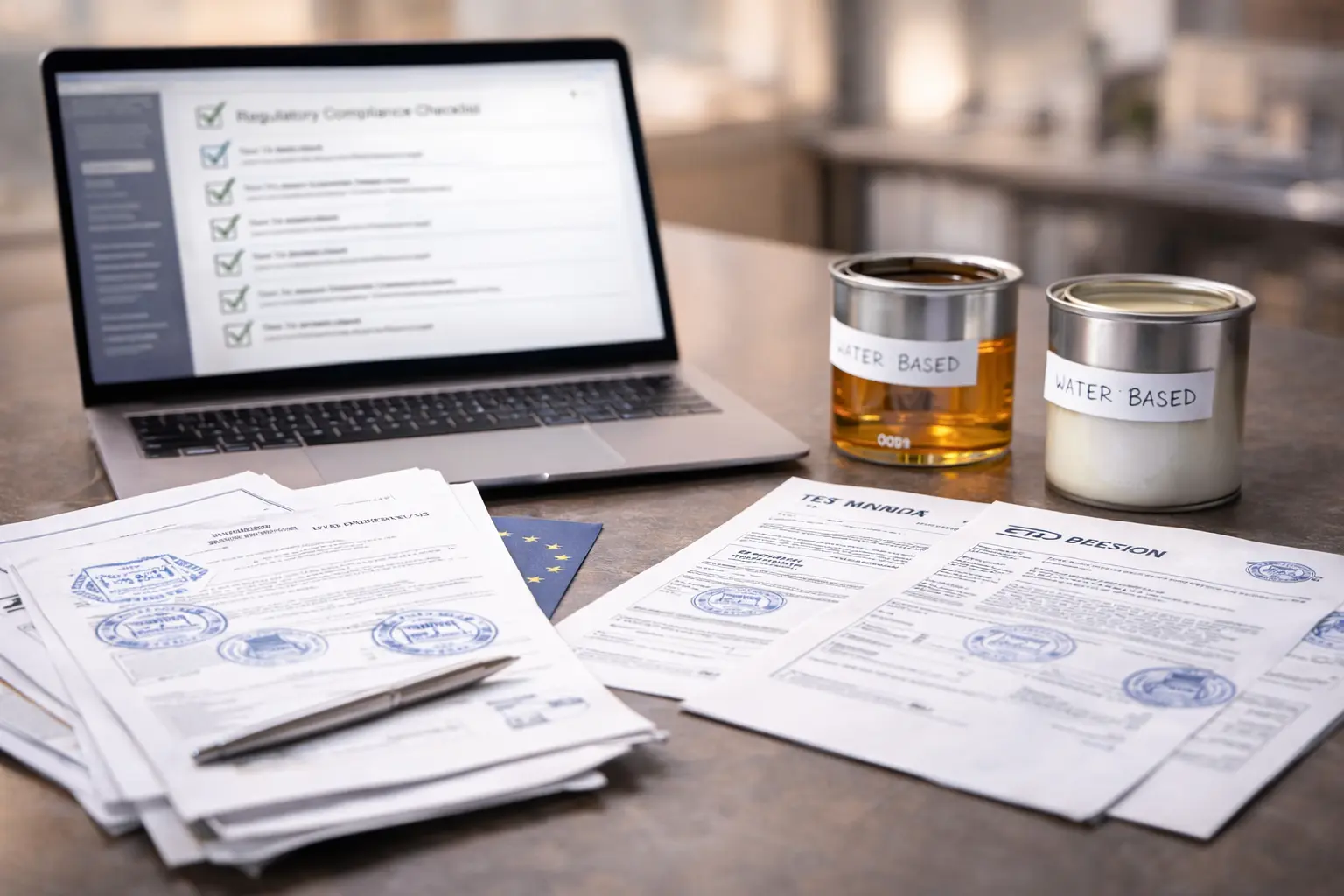
REACH Compliant Adhesive: What Importers Need to Know
A practical guide to REACH compliance for adhesive importers — what the regulation covers, how to verify supplier compliance, and which documents to request.
Read More →Buyer's Guide
VOC regulations are reshaping the global adhesive market. For importers, distributors, and factory buyers sourcing contact adhesives from China, understanding VOC compliance is no longer optional — it is a commercial necessity. Markets across the EU, North America, and increasingly Southeast Asia and the Middle East are tightening limits on volatile organic compounds in industrial adhesives.
This guide covers what low VOC contact adhesive means in practice, the key regulations you need to know, the product types available, and how to verify compliance when sourcing from Chinese manufacturers. Whether you are importing for resale, specifying adhesives for a production line, or developing a private label product, this article provides the regulatory and technical foundation you need.
Volatile Organic Compounds (VOCs) are carbon-based chemicals that evaporate readily at room temperature. In contact adhesives, VOCs primarily come from the solvent carrier — substances like toluene, hexane, acetone, and methyl ethyl ketone (MEK) that dissolve the adhesive polymer and evaporate during the bonding process.
VOC emissions from adhesives create three categories of concern:
For adhesive buyers, VOC content directly affects which markets a product can legally enter, what workplace safety equipment is required, and whether end products meet green building or eco-label certifications demanded by downstream customers.
VOC regulations vary significantly by region. Understanding the specific limits and test methods for your target market is critical when specifying or sourcing low VOC contact adhesives.
The EU regulates adhesive VOCs through multiple frameworks. REACH (EC 1907/2006) restricts specific hazardous substances — including several solvents commonly found in contact adhesives. The Decopaint Directive (2004/42/EC) sets VOC limits for coatings and adhesives used in construction, capping contact adhesives at 650 g/L for most categories. Germany's GEV EMICODE system goes further, classifying adhesives by emission rates: EC1 Plus (very low emission, less than 60 micrograms/m3 TVOC after 28 days) is increasingly required for interior applications.
The US EPA National Volatile Organic Compound Emission Standards set baseline limits, but California's South Coast Air Quality Management District (SCAQMD) Rule 1168 is the most stringent benchmark. Under Rule 1168, contact adhesives are capped at 250 g/L VOC for general use. Special-purpose contact adhesives (for substrates requiring higher-strength bonds) are allowed up to 550 g/L. Many US distributors now require SCAQMD compliance regardless of the end market, as it simplifies nationwide distribution.
China's GB 33372-2020 standard ("Limits of volatile organic compounds content in adhesives") took full effect in 2021. It classifies adhesives into categories and sets maximum VOC content: contact adhesives based on polychloroprene (neoprene) are limited to 550 g/L, while water-based contact adhesives must stay below 50 g/L. This standard applies to manufacturing within China, meaning Chinese factories producing for domestic sale are already subject to measurable VOC limits.
Countries across Southeast Asia, the Middle East, and Africa are progressively adopting VOC regulations. India's BIS standards, Thailand's TIS specifications, and GCC-wide SASO requirements increasingly reference international VOC limits. For exporters and distributors serving these markets, sourcing adhesives that already meet EU or US standards provides a forward-looking compliance buffer.
Low VOC contact adhesives fall into three main categories, each with distinct performance characteristics and trade-offs. The right choice depends on your substrates, production environment, and regulatory requirements.
| Property | Water-Based | High-Solids Solvent | Hot Melt Alternative |
|---|---|---|---|
| VOC Content | Less than 50 g/L | 200-400 g/L | Near zero |
| Bond Strength | Moderate (2-5 N/mm) | High (4-8 N/mm) | Moderate to high |
| Open Time | 30-60 min | 15-40 min | Seconds (no open time) |
| Drying Time | 20-45 min | 10-20 min | Instant (cools to bond) |
| Heat Resistance | Up to 60-80 C | Up to 100-120 C | 40-80 C (varies by type) |
| Best Substrates | Wood, foam, fabric, HPL | All substrates incl. metal | Packaging, assembly, textiles |
| Relative Cost | Medium | Medium-high | Low-medium (equipment cost high) |
| SCAQMD Compliant | Yes | Check per product | Yes |
Water-based contact adhesives use water as the primary carrier instead of organic solvents. VOC content is typically below 50 g/L, making them compliant with virtually all global regulations. They are the most common choice for buyers targeting EU and North American markets. The main trade-off is longer drying time — water evaporates slower than solvents, especially in high-humidity environments. Bond strength on non-porous substrates is generally lower than solvent-based alternatives, but modern latex-polymer formulations have significantly closed the performance gap for wood, foam, and fabric bonding.
High-solids formulations increase the adhesive polymer content to 60-75% (compared to 20-35% in standard solvent-based products), reducing the amount of solvent needed. This lowers VOC content to 200-400 g/L — still above water-based levels, but sufficient for some regulatory thresholds. These products retain the fast drying and high bond strength of traditional neoprene contact adhesives, making them a practical transition option for factories that cannot change their entire bonding process.
Reactive hot melts (PUR and PO-based) contain no solvents and emit near-zero VOCs. They bond on cooling and then crosslink for permanent adhesion. While not traditional contact adhesives, they are increasingly used as replacements in furniture edge banding, automotive trim, and packaging where contact adhesive was previously specified. The major barrier is equipment cost — hot melt application systems require heated dispensers and may need significant line modifications.
Switching from a standard solvent-based contact adhesive to a low VOC alternative is not a drop-in replacement. Buyers and factory engineers should evaluate several performance factors before committing to a product change.
China is the world's largest adhesive manufacturing base, and an increasing number of Chinese factories — particularly in the Guangdong, Zhejiang, and Shandong industrial clusters — now produce low VOC and water-based formulations. However, not all suppliers have the same compliance capabilities. Here is what to evaluate when sourcing.
When evaluating potential suppliers, request samples and conduct your own bond strength and VOC testing on arrival. Laboratory conditions in China may differ from your end-use environment, and independent verification protects both your quality standards and regulatory standing.
A practical guide to REACH compliance for adhesive importers — what the regulation covers, how to verify supplier compliance, and which documents to request.
Read More →
Understand the key differences between solvent-based and water-based adhesives — performance, VOC levels, drying time, and regulatory compliance for industrial use.
Read More →
A detailed comparison of neoprene (CR) and SBS contact adhesives — covering bond strength, heat resistance, cost, and ideal applications for industrial buyers.
Read More →ChinaGluePro offers REACH-compliant and low VOC contact adhesives with SGS-verified test reports. Contact us for samples and technical data.