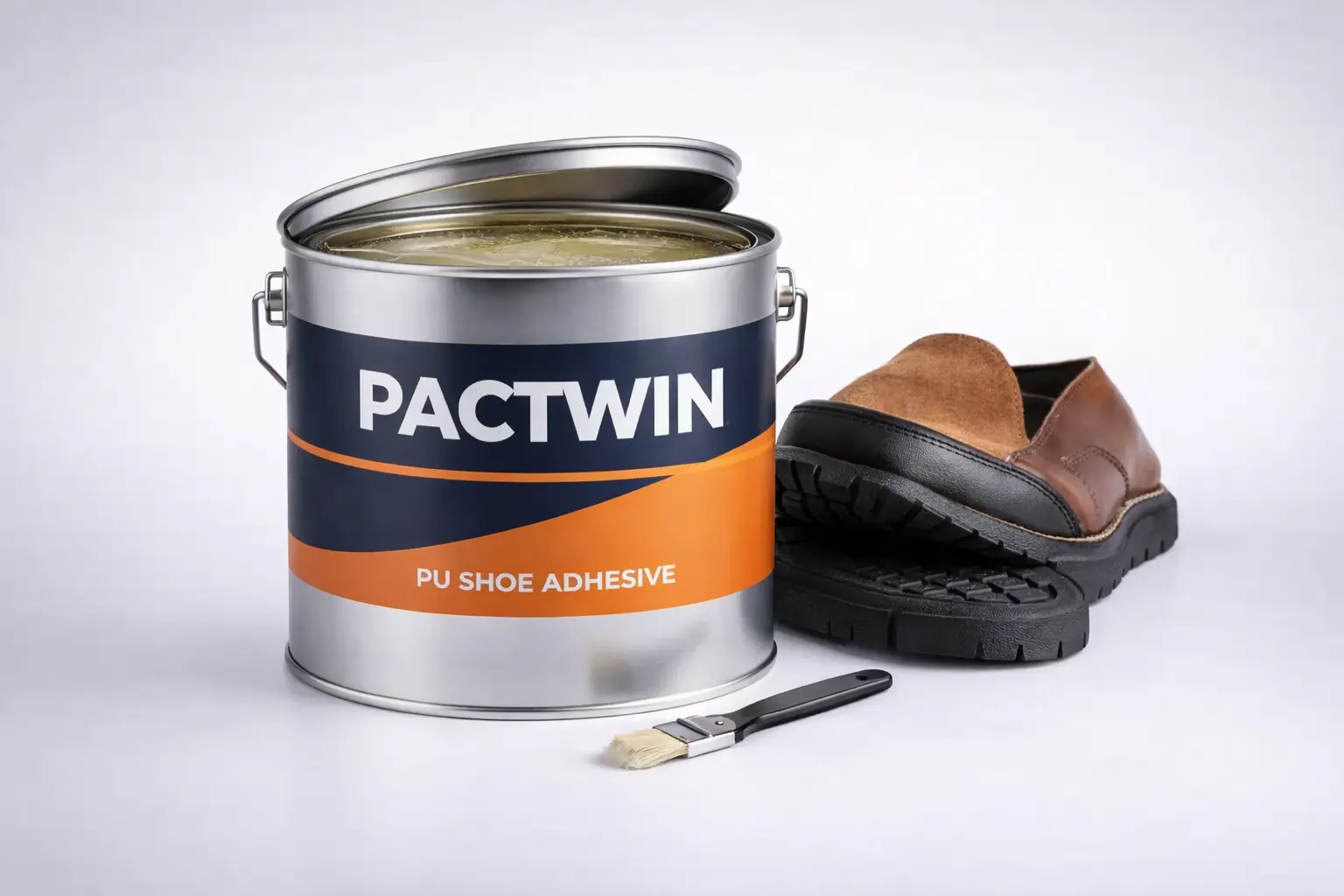
Shoe Adhesive
PU Shoe Adhesive
High-performance polyurethane (PU) adhesive specifically formulated for footwear manufacturing. Delivers superior flex resistance, heat resistance, and bond durability for sole-to-upper bonding.
View Details →Specialized adhesives for footwear manufacturing including PU (polyurethane), neoprene, and water-based formulations. Designed for sole bonding, upper attachment, and lasting operations.
Footwear manufacturing is one of the most demanding adhesive applications in industry. A shoe adhesive must withstand constant flex fatigue as the wearer walks, resist delamination from perspiration and moisture, maintain bond integrity across a wide temperature range, and bond reliably to a diverse range of substrates — natural leather, synthetic leather, fabric, EVA foam, rubber, TPR, PU, and various sole compounds. The adhesive joint in a shoe is subjected to repeated peel, shear, and impact forces throughout the product's service life, making adhesive selection a critical factor in footwear quality and durability.
ChinaGluePro manufactures specialized shoe adhesives engineered specifically for the footwear production environment. Our formulations are developed in collaboration with shoe factories across Southeast Asia and Africa, where we understand the practical requirements of high-volume production lines processing thousands of pairs per day. Each adhesive is optimized for specific bonding operations in the shoe assembly process — from initial upper lasting through final sole attachment.
PU adhesive is the industry standard for permanent sole bonding in modern footwear manufacturing. Polyurethane's molecular structure provides an exceptional combination of high peel strength (≥4.0 N/mm on rubber-to-EVA substrates per EN 1392), outstanding flex fatigue resistance (bond integrity maintained after 100,000+ flex cycles), and heat resistance up to 60°C. PU shoe adhesive is available in one-component moisture-cure and two-component catalyst-cure systems. One-component PU is simpler to use — apply directly from the can with no mixing required — and is suitable for most production lines. Two-component PU provides faster cure and higher ultimate bond strength for high-throughput factories requiring maximum production efficiency. Both systems require heat reactivation at 65-75°C before pressing, which activates the adhesive film and ensures optimal bond formation.
Neoprene shoe adhesive based on chloroprene rubber provides high initial tack and fast bond development, making it essential for intermediate bonding operations in shoe production. It is the primary adhesive for upper assembly and lasting (pulling the upper over the last and bonding it to the insole), insole and midsole lamination, heel counter and toe puff attachment, and general footwear workshop bonding tasks. Neoprene shoe adhesive offers heat resistance up to 90°C — higher than standard contact adhesive — and achieves peel strength of ≥2.5 N/mm on leather-to-rubber substrates. For casual and economy footwear lines, neoprene adhesive can serve as the sole bonding adhesive, though PU is recommended for athletic and premium footwear.
Water-based shoe adhesive addresses the growing demand for low-VOC production in footwear factories, particularly those supplying brands with strict environmental compliance requirements. These formulations replace organic solvents with water-based polymer dispersions, reducing VOC emissions by over 90%. While bond strength on porous substrates approaches solvent-based performance, water-based shoe adhesive requires longer drying times and is more sensitive to ambient temperature and humidity. It is best suited for factories with controlled environments and production lines designed for extended drying station layouts.
Primers are a critical component of the footwear bonding system. Many sole materials — EVA, TPR, certain rubbers, and PU soles — have low surface energy that prevents direct adhesive bonding. Primers chemically modify the substrate surface to create reactive bonding sites that dramatically improve adhesion. ChinaGluePro supplies specific primers for EVA, rubber, PU, and TR substrates, along with halogenation agents for polychloroprene treatment. Proper primer selection and application is often the single most important factor in achieving reliable sole bond performance.
Sole bonding follows a precise sequence of steps, and each step affects final bond quality. The standard process in a modern shoe factory proceeds as follows:
High-performance polyurethane (PU) adhesive specifically formulated for footwear manufacturing. Delivers superior flex resistance, heat resistance, and bond durability for sole-to-upper bonding.
View Details →
Chloroprene rubber (CR) based shoe adhesive for footwear assembly, upper bonding, and insole lamination. Provides strong immediate tack and reliable bond performance for high-volume production.
View Details →Our technical team works directly with footwear factories to optimize adhesive selection, application processes, and bond performance. Contact us to discuss your production requirements.